Skip to content




December is one of the driest months in Oviedo, but your outdoor outlets still get wet. Heavy morning dew settles on plugs and cords, and sprinklers still run once a week on the winter watering schedule. A sprinkler head aimed at the wall can soak an outlet in seconds.
So yes, plug outdoor holiday lights into a GFCI-protected outlet. A ground-fault circuit interrupter (GFCI) cuts power in a fraction of a second when current leaks through water or a person, before a shock can do serious harm. If your outlet has no GFCI, fails its test or keeps tripping, fix that first.
Do Outdoor Holiday Lights Need a GFCI Outlet in Florida?
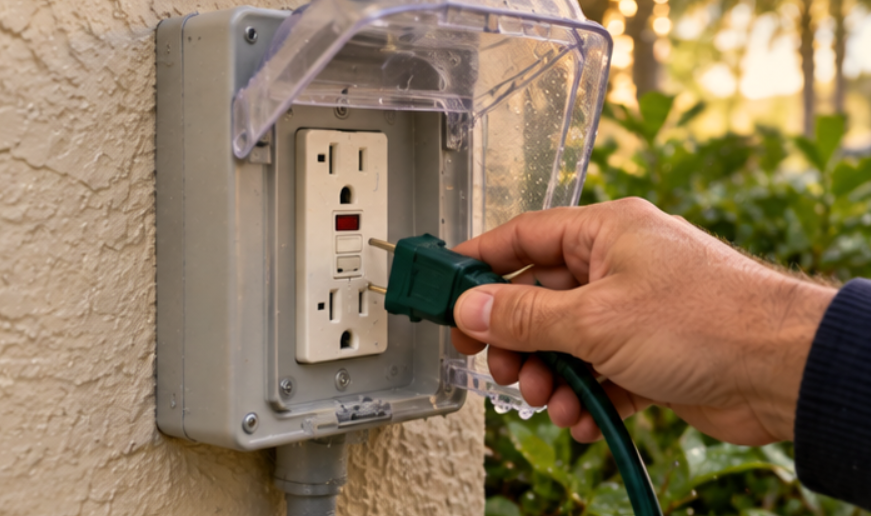
Yes, and the electrical code says so. Section 210.8 of the National Electrical Code (NEC) requires GFCI protection on outdoor outlets at homes, and Florida adopts the 2020 NEC through the current Florida Building Code. Older homes may predate that rule, so do not assume your outlet has it.
A GFCI compares the current going out on one wire with the current coming back on the other. If even a small amount goes missing, it trips. It cannot make a cracked cord or a plug sitting in a puddle safe, though, so the rest of the setup still matters.
The same code calls for weather-resistant outlets and in-use covers in wet spots. An in-use cover, sometimes called a bubble cover, closes over the plug while it is in use, so dew and sprinkler spray stay off the connection.
How Can You Tell If Your Outdoor Outlet Has GFCI Protection?
Look for two buttons labeled TEST and RESET on the outlet. Pressing TEST should trip the device and interrupt power; RESET should restore power if the device and circuit are functioning properly. Follow the manufacturer’s testing instructions.
An outlet without these buttons may still be protected by a GFCI elsewhere on the same circuit. Plug a lamp into the outdoor outlet, then use the checklist below to find what protects it.
Use this quick checklist:
- Check the garage and bathrooms: Press TEST on each GFCI there and see whether the lamp goes off.
- Inspect the electrical panel: A breaker with its own TEST button is a GFCI breaker.
- Reset what you tripped: Press RESET on every device you tested before you move on.
- Watch for warning signs: A device that fails testing or will not reset needs attention.
- Ask an electrician: Have the circuit checked if you cannot confirm protection.
If the lamp stays on through every test, the outlet has no GFCI protection, even though it powers your lights. Adding one is usually a short visit for our electrical team in Oviedo.
Why Does My Outdoor Outlet Keep Tripping With Holiday Lights?
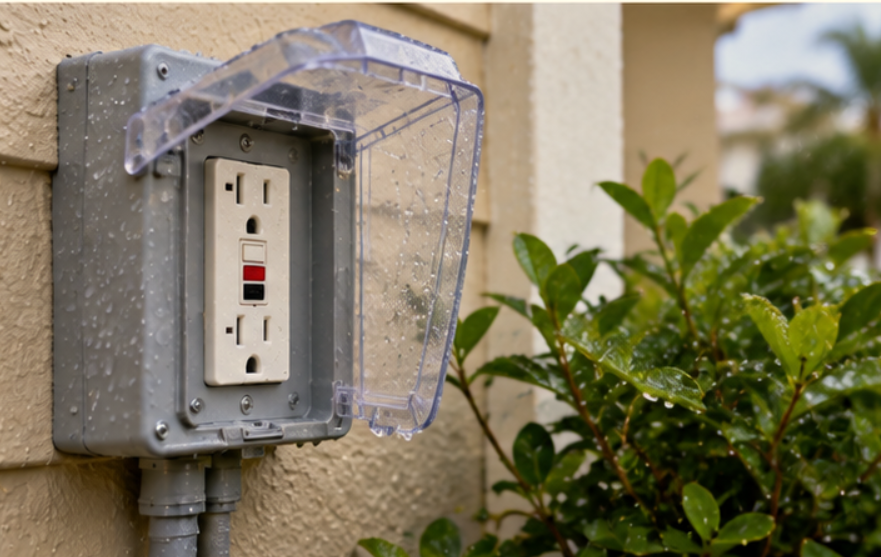
A GFCI that trips is doing its job. It has found current leaking somewhere, and the usual causes are water, a damaged strand or too many strands on one outlet. Resetting it again and again without finding the cause leaves the hazard in place.
Moisture in the Outlet or Connections
Dew and sprinkler water work into plugs, cord connections and the outlet itself, and the GFCI trips as current leaks through the water. Keep connections off the ground and point sprinkler heads away from outlets. Florida’s humidity affects your home’s electrical system all year, so a trip after a damp night is a warning, not a fluke.
Too Many Strands on One Outlet
Every strand leaks a tiny amount of current, which is normal. Plug enough strands, inflatables and timers into one GFCI and those small leaks add up until it trips. Too much total load is a different problem, and it trips the breaker in the panel instead. Spread the decorations across more than one circuit.
A Worn or Faulty GFCI Outlet
GFCI devices can deteriorate or fail over time. If your outlet will not reset, fails its built-in test, or trips even when the holiday lights are disconnected, the device or circuit may need professional testing. Moisture, damaged wiring, and other electrical faults can cause similar symptoms, so avoid assuming that replacing the outlet alone will solve the problem.
Damaged Holiday Lights or Extension Cords
Cracked insulation, bent prongs, loose plugs, and damaged connectors can create electrical hazards, especially outdoors. Inspect every strand and extension cord before use, and replace damaged products rather than attempting temporary repairs with tape. Choose outdoor-rated cords, prevent doors or windows from pinching them, and avoid connecting multiple extension cords unless the equipment instructions specifically allow it.
Never Bypass a Tripping GFCI
A GFCI that repeatedly trips is warning you about a possible electrical problem. Never replace it with a standard outlet or disable its protection simply to keep the holiday lights running. If the outlet is wet, damaged, unusually hot, sparking, or producing a burning smell, stay away and contact a qualified electrician. Disconnect equipment only when it is safe to do so.
What Do Common GFCI Problems Mean?
Match what you see to the table, and it points you to the likely cause and the next step.
| What you notice | Possible cause | What to do |
|---|---|---|
| Trips after rain | Moisture or an electrical fault | Stop using the setup and check for damage when safe |
| Trips with several strands | Excessive load or cumulative leakage | Check product limits and circuit capacity |
| Trips with lights disconnected | Faulty device or wiring problem | Arrange professional testing |
| Will not reset | Device failure or unresolved fault | Leave the outlet unused |
| No visible TEST and RESET buttons | Protection may be provided elsewhere or absent | Confirm GFCI protection |
| Breaker trips when lights turn on | Overload, short circuit, or other fault | Stop using the affected setup and investigate |
These symptoms are clues, not definitive diagnoses. If the problem repeats or you cannot confirm the cause, have the outlet and circuit inspected before reconnecting the decorations.
How Can You Make Outdoor Holiday Lighting Safer in Florida?
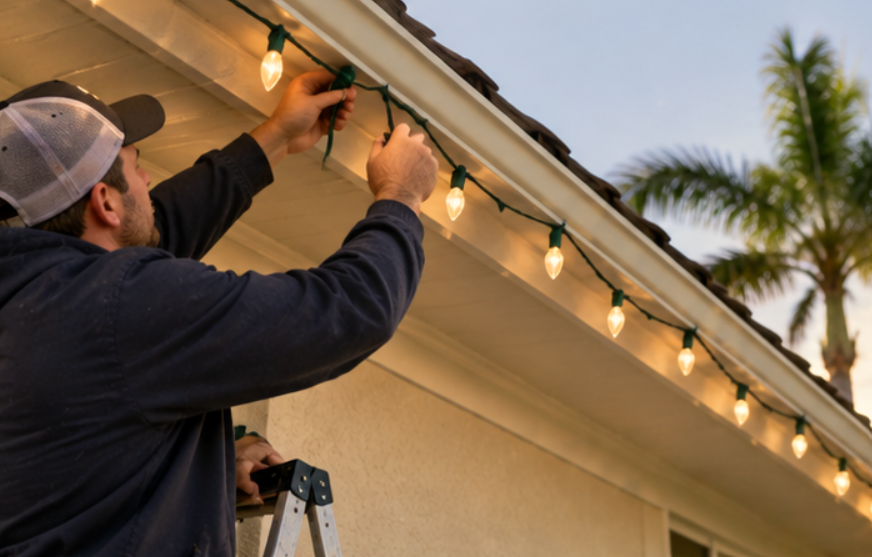
Most of the risk comes down to the gear you use and where you run it. Before the lights go up, work through this list.
- Choose outdoor-rated lights: Check product labels before installing decorations outside.
- Use suitable extension cords: Indoor cords are not substitutes for outdoor-rated products.
- Keep connections dry: Lift plugs off the ground and out of sprinkler spray.
- Protect receptacles: Use appropriate weatherproof covers designed for outdoor use.
- Inspect every strand: Replace cords with cracked insulation or damaged plugs.
- Follow connection limits: Never exceed the manufacturer’s recommended number of connected strands.
- Avoid overloaded circuits: Distribute electrical loads appropriately.
- Secure cords safely: Keep them away from walkways, sharp edges, and lawn equipment.
- Turn off questionable equipment: Do not leave damaged or unsafe lighting connected to power.
If you decorate every year, permanent outdoor lighting can save you the ladder work. Our outdoor and landscape lighting installation is wired and protected for Florida weather from day one, and we handle outdoor lighting in Orlando too.
When Should You Call an Electrician About an Outdoor Outlet?
Contact a qualified electrician if your outdoor outlet lacks confirmed GFCI protection, fails testing, will not reset, or repeatedly trips without an obvious cause. Professional inspection is also important if you notice sparks, a burning smell, unusual heat, visible outlet damage, or signs of water intrusion.
Never touch a wet receptacle or attempt to open it while moisture may be present. Keep people away from the affected area and seek professional assistance. If a breaker repeatedly trips, do not keep resetting it without identifying the cause.
When you hire an electrician, look up the license on the state’s search at myfloridalicense.com, ask what testing the work includes and get a plain explanation of the repair. Our list of mistakes to avoid when hiring an electrician covers the rest.
Why Choose R&A Industries for Electrical Service in Oviedo?
Electrical work is where R&A Industries started as a family business, years before we added plumbing and air conditioning. That history shows on small jobs like this one, where the right fix might be a single GFCI in the right spot, not a rewired circuit.
Our Oviedo electricians test outdoor outlets, install GFCI and weather-resistant outlets with in-use covers, and track down GFCIs that will not stay reset.
If an outlet is sparking, hot or smells of burning, call our Oviedo emergency electricians. For everything else, call (407) 384-0034 and get your outdoor outlets checked before the lights go up.
Frequently Asked Questions
Can I Plug Holiday Lights Into a Regular Outdoor Outlet?
Only if a GFCI protects that outlet from somewhere else on the circuit. If nothing does, a plug-in portable GFCI adapter makes the setup safer for the season, and a permanent GFCI outlet or breaker is the lasting fix.
Is a Weather-Resistant Outlet the Same as a GFCI Outlet?
No. A weather-resistant outlet, marked WR on its face, is built to resist corrosion and sun damage outdoors. A GFCI protects you from shock. An outdoor outlet should be both, and many outdoor GFCI outlets carry the WR mark too.
Do LED Holiday Lights Need GFCI Protection?
Yes. LED lights draw far less power than older strands, but the shock risk comes from water and damaged cords, not from how much power the bulbs use. The outlet they plug into needs GFCI protection either way.
Are Outdoor Timers and Smart Plugs Safe for Holiday Lights?
Yes, if they are rated for outdoor use and plug into a GFCI-protected outlet. Mount the timer or smart plug off the ground and under cover, since its connection sits right where dew and spray collect. An in-use cover over the outlet can often close over a small timer too.
How Often Should I Test My Outdoor GFCI Outlet?
Follow the manufacturer’s testing instructions. Many manufacturers recommend monthly testing, and testing before installing seasonal decorations is a sensible precaution. If the device fails to trip or will not reset, have it evaluated before relying on it for protection.
Do I Need an Electrician to Install an Outdoor GFCI Outlet?
A qualified electrician can check the existing circuit, confirm the required protection, and install suitable outdoor-rated equipment. Professional evaluation is particularly important when wiring needs modification, the outlet is damaged, or the GFCI repeatedly trips.