


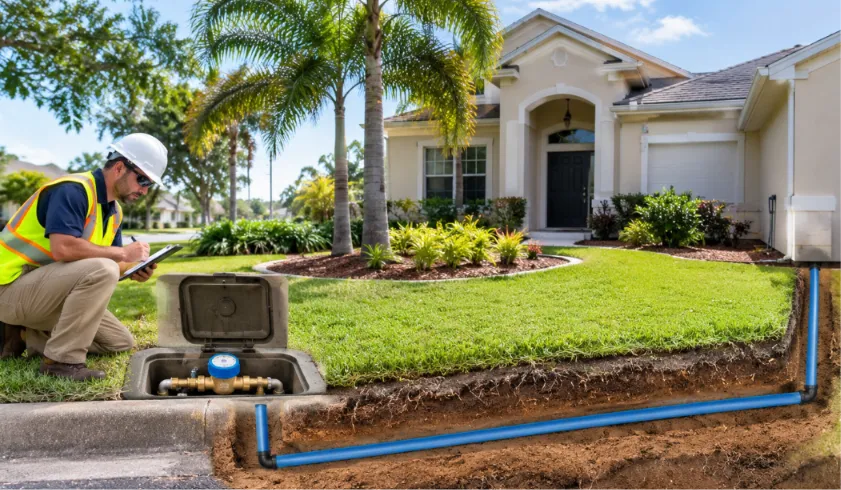
In most cases, no. Responsibility for the water line from the meter to the house usually falls on the property owner. The utility owns the main under the street and the pipe up to the meter. A leak in your yard is usually yours to fix.
Maybe your bill jumped, or a strip of lawn near the meter box stays soggy. At R&A Industries in Oviedo, our plumbers locate the leak first and dig second. This guide shows who owns each part of the line and who to call.
Who Owns Which Part of the Water Line
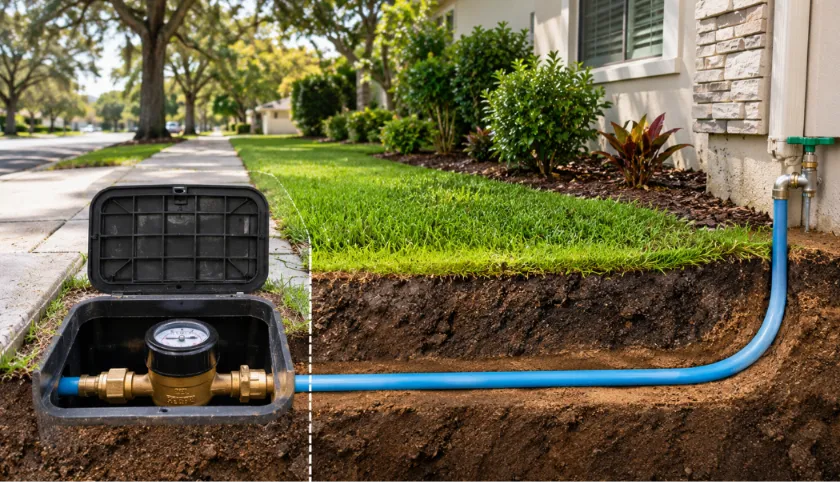
Your water service line has two parts, and the meter usually marks where they meet. On one side, the utility’s pipe comes from the main to the meter. On the other, your pipe runs underground across the yard to the house.
Main to Meter, Owned by the Utility
Seminole County Utilities says it owns the pipe between the water main and the property line or meter. So leaks on that stretch are the utility’s to repair. However, most homes inside Oviedo city limits get water from the City of Oviedo instead. The city runs about 14,000 meters.
Meter to House, Owned by You
Seminole County lists the pipe from the property line or meter to the house as the owner’s. The City of Oviedo does not spell out its split online. For that reason, city customers should confirm it with Utility Customer Service before anyone digs.
City of Oviedo Utility Customer Service · 407-971-5535
How to Tell Which Side the Leak Is On
The meter records every gallon that passes it. A leak after the meter shows up on your bill even when no faucet runs. These five checks take a few minutes each and point you to the right call.
Do the Meter Test
First, turn off every faucet, appliance and irrigation zone, then look at the meter. Most have a small leak indicator, often a triangle or dial, that spins when water moves. If it spins with everything off, water is escaping after the meter, on your side.
Look for a Soggy Strip of Lawn
A buried service line usually runs fairly straight from the meter to the house, often toward the hose bib. Watch that path for a wet, green or sunken strip, especially in dry weather. It is a strong sign of a leak on that line.
Compare Your Water Bills
A leak on your side shows up as higher use month after month with no change in habits. So compare your last three or four bills. A steady climb, or a jump with no new pool, guests or landscaping, points to water escaping after the meter.
Check Water Pressure in the House
Also, a large leak on the service line steals pressure before water reaches your fixtures. Is every faucet and shower weak at once, not just one fixture? Then the line between the meter and the house may be leaking or partly blocked.
Watch for Water at the Meter Box
Water pooling in or around the meter box is the one sign that may belong to the utility. In that case, the leak could be at the meter or the utility’s connection, not your pipe. Report it to the utility first and let them confirm which side it is on.
Overall, most leaks people spot in the yard turn out to be on the owner’s side. The meter test is free and settles the question before you call anyone.
Should You Wait for the City to Come Look?
Still, calling the utility makes sense when water pools at the meter box, and many will send someone to check their own equipment. If the leak turns out to be past the meter, they will usually tell you to call a licensed plumber.
Meanwhile, waiting costs money. The meter keeps counting water you pay for, and a leak on your side softens the soil under walkways and driveways. A slow response tends to make both the repair and the bill bigger.
Both local utilities allow one leak adjustment every 24 months. The City of Oviedo limits it to one request in that window, and Seminole County Utilities calls it a courtesy adjustment. Keep the plumber’s invoice as proof of the repair.
Who to Call for Each Part of the Line
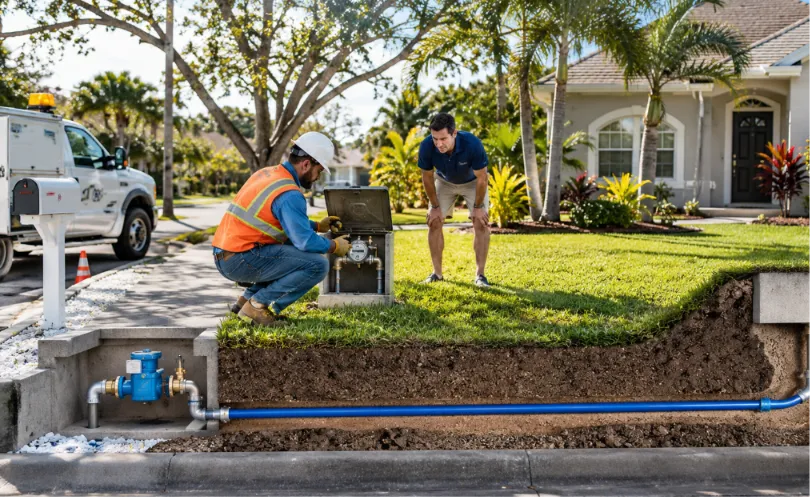
Once you know where the problem is, the next call is easy. Here is the usual split between the utility and the owner. The utility named on your bill sets the exact rules for your address.
| Part of the line | Who usually owns it | Who to call |
|---|---|---|
| Water main under the street | Utility | Utility |
| Line from the main to the meter | Utility | Utility |
| Meter and meter box | Utility | Utility |
| Line from the meter to the house | Property owner | Licensed plumber |
| Irrigation backflow preventer | Property owner | Licensed plumber |
| Pipes inside the house | Property owner | Licensed plumber |
Not sure who supplies your water? Check the name on your bill. The City of Oviedo and Seminole County Utilities each set their own rules for leaks, bill adjustments and after-hours response.
What a Water Line Repair Involves
A service line repair is mostly about finding the leak precisely, so the yard is opened once in the right place. Good leak detection listens for escaping water and tests pressure along the line before any shovel goes in.
After that, most repairs follow the same few steps. The details depend on how deep the line runs and what it is made of. They also change when a driveway, tree or sprinkler line sits on top, which is common in older Oviedo neighborhoods.
- Pinpoint the leak with detection equipment.
- Shut off the water at the meter to keep the work area dry.
- Open only the patch of yard above the leak.
- Fix the damaged section, or replace the run if the pipe is failing.
- Pressure-test the line, then fill the trench and restore the yard.
Should You Repair the Leak or Replace the Line?
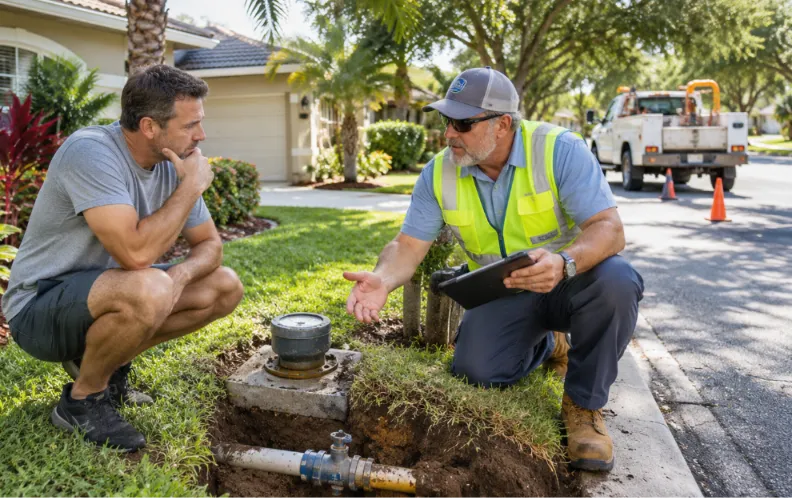
A single leak on an otherwise sound line is usually worth repairing. A line that keeps leaking is different. Each repair means another dig, another bill and more water lost before the next failure.
Replacement makes more sense when the line shows these signs. Older Central Florida homes show them most, especially homes still on galvanized steel or polybutylene. Polybutylene is a plastic supply pipe common in homes built from the late 1970s into the mid-1990s.
- Two or more leaks have hit the same line within a few years.
- The pipe is galvanized steel or polybutylene.
- Flow stays weak throughout the house after a repair.
- Rust-colored water comes from every tap, a sign of corroding pipe.
Are the pipes inside the walls just as old? Then repiping the house at the same time can save a second round of work. A plumber can tell you whether the outside line and the inside pipes share the same material and age.
R&A Industries Finds and Fixes Service Line Leaks
Whether the leak sits on the owner’s side or the whole line is worn out, the fix is a plumbing job. We handle leak detection, water line repair and replacement, whole-home repiping, emergency plumbing and drain work. One company can trace the problem from the meter to the faucet.
Family-owned since 2001, R&A Industries runs its plumbing under Florida license CFC1433199. Customers give us a 4.9 stars rating on Google. Check our service areas page to see if your street is covered.
Our flat $120 home visit pays for the trip and the first 30 minutes on the job. Larger repairs can be financed through Wisetack, with terms set by your credit.
Seeing a soggy strip or a bill that keeps climbing? Call us to find the leak and confirm which side of the meter it is on. Outside office hours, the main number still connects you to our answering service.
[Call (407) 384-0034]
Frequently Asked Questions
Who is responsible for the water line in a condo or HOA community?
It depends on the community’s governing documents. In many condos, the association owns shared lines up to each unit. In HOA neighborhoods with single-family homes, each owner usually has the line from the meter to the house. Check your declaration or ask the manager before you hire anyone.
Is a water service line leak an emergency?
A slow leak can usually wait a day or two for a plumber. Water bubbling up, a sinking patch of ground or a sudden loss of pressure cannot. Because the house shutoff sits past the leak, ask your utility to close the valve at the meter, then call a plumber.
Does a water line repair mean tearing up my driveway?
Not always. When a leak sits under a driveway or slab, a plumber can often route a new section of line around it. The concrete stays in one piece. The old pipe is capped and left in place. Ask about this option before you agree to any demolition.
What pipe is used to replace a main water line?
Common choices are PEX, copper and polyethylene, a flexible plastic pipe made for buried lines. The right one depends on the soil, the distance and local code. PEX and polyethylene resist the corrosion that wears out galvanized steel, which is one reason they are popular for replacements.
Does homeowners insurance cover a water line leak?
It depends on your policy. Many policies cover water damage inside the home but leave out the buried line itself. Some cover the line only with an added service line endorsement. Check with your agent before the repair, and keep photos and invoices for any claim.